Showing posts with label Rodney Gilfry. Show all posts

Sunday, 22 October 2023

Heggie - Dead Man Walking (New York, 2023)


Jake Heggie - Dead Man Walking

The Metropolitan Opera, 2023

Yannick Nézet-Séguin, Joyce DiDonato, Ryan McKinny, Susan Graham, Latonia Moore, Rod Gilfry, Krysty Swann, Wendy Bryn Harmer, Chauncey Packer, Helena Brown, Briana Hunter, Magdalena Kuźma, Matteo Omoso Castro, Alexa Jarvis, Justin Austin, Chad Shelton, Raymond Aceto, Regan Sims, Mark Joseph Mitrano, Jonah Mussolino, Christopher Job, John Hancock, Patrick Miller, Jonathan Scott, Earle Patriarco, Ross Benoliel, Tyler Simpson

The Met: Live in HD - 21st October 2023

It's the start of a new Met Live in HD Season, and no longer enjoying the star power of Anna Netrebko since their falling out over the war in Ukraine as a draw for the opening broadcast, the Metropolitan Opera in New York have instead chosen to go down an unexpected route of promoting contemporary American composers, as they did with Terence Blanchard's incendiary Fire Shut Up In My Bones in 2021. It's a risky strategy, but as Peter Gelb acknowledged in the introduction before the cinema relay, perhaps a necessary one for the Met to change and recognise opera as a relevant contemporary creative artform, not just a revival of music composed centuries ago. And presumably, such an approach might be necessary to attract new younger and more diverse audiences.

To that end not only does the 2023/24 season open with the Met premiere of Jake Heggie's Dead Man Walking, but the next two broadcasts are also new or modern works, X: The Life and Times of Malcolm X by Anthony Davis and Florencia en el Amazonas by Daniel Catán. That is certainly an appealing line-up for me, at least in as far as having the opportunity to experience unfamiliar works in the next best way to seeing them live (which would be highly unlikely outside of the United States in any case). The Met have their Live in HD broadcasts down to a fine art, and that was certainly the experience with their completely stunning production of Dead Man Walking.

Composed in 2000, and having the distinction of being the most successful or at least most widely performed (in America) new opera of the 21th century (so far), the Met are late catching on to Jake Heggie's first opera, but they certainly make up for it with a production that does the work full justice and which may even consolidate its reputation and popularity. I'm late to the work myself, as American contemporary composers are not particularly fashionable in Europe and rarely get performed here. As if seeking to make that cross-over, the Met chose the Belgian experimental opera and theatre director Ivo van Hove to direct their first production of the work, and that was enough to entice me out to see it in the cinema, when I otherwise might not have. I'm very glad I did, and it will certainly bring me back to see their other new productions this season.

Some of my initial hesitation and doubts about having any interest in Dead Man Walking would have been down to it being made into a film (that admittedly I haven't seen) and the subject matter. Although based n a real life story of a nun, Sister Helen Prejean and her memoir of the friendship she struck up with a man on Death Row in the days leading up to his execution, it not only seemed to me designed to stir emotions and gain Oscar nominations, but I imagined that the opera would have similar intentions and be a little ...well, over-emphatic perhaps if not overly sentiment stirring. And it turns out there is some truth in this, Heggie and his librettist Terrence McNally designing the opera to play out as much like a movie screenplay as an opera follow along similar lines, which is where the choice of Ivo van Hove to direct it comes across as a true masterstroke.

Ivo van Hove is a theatre director who is used to working with cinematic drama. He has adapted Bergman's 'After the Rehearsal' and 'Scenes From a Marriage', Cassavetes' 'Opening Night' and Visconti's 'Ossessione' among many film adaptations for the stage, but he also brings a cinematic quality to his plays, using on-stage cameras and projections. His opera productions have similarly benefitted from these kind of techniques that open up backgrounds and underlying tensions, but his success with opera is as much in his ability to draw marvellous acting performances out of the principals and the secondary singers, using every means to express the maximum impact and insight out of whatever he is working on.

Surprisingly, for Dead Man Walking he is much more restrained in how he presents the work, settling for a minimalist set with lots of open space and limited use of on-stage camera-operators and projections. I thought at first that he might be reining in any excesses for an audience less used to experimental European theatre, but it soon became clear that van Hove was actually just serving the needs of the opera Dead Man Walking. Aside from the filmed opening sequence depicting the murders, the menacing prison scenes with guards and prisoners seeming to erupt out of swirling infernal mists, his direction here allows the drama to focus and bring out what is already well-scripted and scored in the relationship between Sister Helen and Joseph De Rocher, letting the characters come alive through their words and interaction rather than employing and of his usual tricks and techniques.

That is almost certainly the right way to approach Heggie and McNally's Dead Man WalkingIvo van Hove makes what could otherwise be film-like theatrical, as well as theatrical for the big screen in the cinema broadcast. Such is the nature of the subject, the direct way it is handled in the superb libretto and the sometimes heavy-handed score by Heggie, that any further emphasis or extraneous action would be too much. Scene after scene had huge emotional impact, and the director doesn't get in the way of that. The final execution scene, as is surely intended, is almost devastating, the director here choosing to get right in close on the act of delivery of the lethal injection with a hand-held camera projecting the procedure. If the rights or wrongs of capital punishment are largely left to the viewer to decide, the inhumanity of taking another's life is not and the production makes sure you see exactly what it entails.

I'm not sure what I expected from Heggie's score, not being familiar with the composer, but his writing for this opera surprised me. He is stated as being in the American tradition - whatever that is, Bernstein maybe? - but Dead Man Waking reminded me of Poulenc and Dialogues des Carmélites. Perhaps the amount of nuns on stage influenced that idea, but I think emotionally, thematically, structurally and musically it's a close match. It's powerfully composed for maximum impact, if perhaps a little too over-emphatic and bombastic in places under the musical direction of Yannick Nézet-Séguin, but I'm sure he delivered it the way the composer intended. It certainly achieves the desired impact; invigorating and draining at the same time.

As well as every other element of the production being up to the extremely high standards of the Metropolitan Opera, the casting of the principals, the singing and acting performances are simply beyond reproach. Every role, not just the central relationship between convict and nun, is filled with character, the performances consequently utterly committed to doing them justice and superbly delivered. You couldn't expect more from Joyce DiDonato and Ryan McKinny, both absolutely rivetting, but it's hard to imagine anyone surpassing the deeply felt emotional delivery of Susan Graham as De Rocher's mother. Secondary roles are just as well written and performed, with Rod Gilfry in particular standing out as the father of the murdered girl, but impressive performances also from newer Met singers Latonia Moore, Krysty Swann, Wendy Bryn Harmer, Chauncey Packer all providing notable performances, particularly in the family scenes with overlapping dialogue and raw emotion pouring out.

While I am instinctively suspicious of work that is this emotionally charged and direct, it's almost impossible for any aspect of Dead Man Walking to be "too much" considering the subject and the way it demands to be presented. No one element however overshadows another in the Met's 2023 production, everything comes together to present Jake Heggie's opera in the best possible light, from these incredible singing and acting performances and the perfectly pitched direction. Even the Live in HD presentation is just perfect, engaging the cinema audience with the filming, the close-ups, Ivo van Hove's own on-screen camera and split-screen shots, making this feel like they were sharing something truly remarkable and even momentous. Impressive on big screen, the video capture of this final performance will no doubt continue to resonate and secure the place of Dead Man Walking in the American contemporary opera canon.


Monday, 14 August 2017

Dean - Hamlet (Glyndebourne, 2017)


Brett Dean - Hamlet

Glyndebourne 2017

Neil Armfield, Vladimir Jurowski, Allan Clayton, Barbara Hannigan, Sarah Connolly, Rod Gilfry, John Tomlinson, Kim Begley, David Butt Philip, Jacques Imbrailo, Rupert Enticknap, Christopher Lowrey

Medici - 6th July 2017

The creation of a new opera based on 'Hamlet' is no minor event in the opera calendar and with all eyes on Glyndebourne and a streamed live performance of the new works, there must be considerable pressure to do this Shakespeare work right and make an impact. All credit to the creators and performers involved then, since Brett Dean's Hamlet proves to be a not only a very good adaptation of Shakespeare but a strong operatic drama in its own right.

The challenge with making an opera out of 'Hamlet' would I imagine be much the same as any other many attempts to adapt Shakespeare, only more so. It involves keeping the essence and tone of the work intact, while having to make drastic cuts, and 'Hamlet' is one of Shakespeare's longest, most complex and surely difficult plays to work with, involving such difficult choices even for the dramatic stage.

As with Ambroise Thomas's Hamlet, it's essential to keep key scenes and speeches, but that alone is not enough - certainly not in the case of Thomas. Brett Dean and his librettist Matthew Jocelyn however have one major advantage over most other opera adaptations of Shakespeare in that they can retain much of the original English text and the rich poetry of the original. Dean's Hamlet then is not exactly word-for-word, but often close to the original, paying particularly attention to the delivery of the play's most famous and important lines.


The other critical factor in making it work as a dramatic piece which can't be underestimated (and again something that applies equally to any performance of the stage play), is finding capable performers with the ability to breathe life and personality into the characters. With an extraordinarily strong cast that includes Allan Clayton, Barbara HanniganRod Gilfry, Sarah Connolly and John Tomlinson, Glyndebourne's world premiere performances certainly have the strongest assembly of singers possible for these roles.

Allan Clayton gives it everything as Hamlet, but crucially finds that essential need to make the Prince's wilful madness sympathetic and not just morbidly obsessive or a raging madman. To do that, you also have to make Claudius and Gertrude convincing and - critically - establish those connections and contrasts of outlook in their interaction. This is something that is brought out not only through the medium of Ophelia (played with agonising sincerity and determination by the outstanding Barbara Hannigan who brings the mad scene back into modern opera in a spectacular fashion) and her father Polonious, but also by the supporting characters (in the fullest sense of supporting and character) by Horatio, by Laertes and even by Rosencrantz and Guildenstern.

Essentially then, there are no 'supporting characters' as such, as its the interaction between them all that creates a complex situation of conflicting purposes and personalities. And the Glyndebourne casts it as such with Rod Gilfry and Sarah Connolly stamping their personality all over Claudius and Gertrud with tremendous singing performances, but also with the likes of Jacques Imbrailo singing Horatio, Kim Begley as Polonious and John Tomlinson singing the ghost of Hamlet's father, one of the players and the gravedigger. All of these figures could easily be side-lined by the need to cut and condense, but it's to the credit of the opera that there is recognition that they are not just there to provide colour, but have a vital dramatic role to play in the work.

The question remains however whether Shakespeare gains anything from being adapted to the opera stage, and perhaps it never really does. The real question however is whether - again like any stage production of the play - it serves the work and can bring a certain character of its own to bear on a great work. Musically, Dean's music rarely calls attention to itself, and certainly doesn't over-assert itself over the inherent force of the drama and the language, but rather it controls mood and pacing, hinting at deeper tensions and stirring trouble, bringing some dramatic emphasis where necessary. It does well in the manner that the music and repetition can highlight certain words and phrases, overlaying them in a way that traditional theatre cannot to bring opposing views into even starker contrast.


Brett Dean's Hamlet can then be quite difficult to follow in a single viewing, even for those familiar with the play. Actually, familiarity with 'Hamlet' can even make things more difficult, since you find yourself looking for dramatic cuts and variances, looking for interpretation of familiar themes and considering how it measures up to the original. That can lead to the music not being given the same due attention for the role it plays that the singing performances receive, but together there is no question that Dean's Hamlet grips and holds attention and relates the story of Hamlet, Prince of Denmark with considerable fidelity as a good opera drama, as well as having something of its own to contribute to its telling. The finale, as good a measure of a 'Hamlet' as any other scene, is outstandingly staged and musically set. All the more for having Rosencrantz and Guildenstern die an on-stage death at this point along with almost everyone else.

The stage direction of Neil Armfield and the conducting of Vladimir Jurowski have no small part to play in the success of the endeavour. The set design is all tall panels from a rich mansion that shift and slide to reveal the darkness behind, the opera flowing seamlessly from one scene to the next. The costumes are modern-dress, the nobles wearing suits and formal dresses, the others a little shabbier, with Hamlet and Ophelia's descents into madness (whether feigned or real) reflected in the increasing disarray of their outfits. Everyone is pale pansticked white-faced. It's a thoroughly nightmarish 'Hamlet' world. Jurowski handles the complexities and lovely idiosyncrasies of the musical arrangements well, the score and the performances allowing the qualities of the libretto and the singing the fullest expression.

Links: Glyndebourne, Medici

Monday, 18 July 2016

Mozart - Così fan tutte (Aix-en-Provence, 2016)


Wolfgang Amadeus Mozart - Così fan tutte

Festival d'Aix-en-Provence, 2016

Louis Langrée, Christophe Honoré, Lenneke Ruiten, Kate Lindsey, Sandrine Piau, Joel Prieto, Nahuel di Pierro, Rod Gilfry

ARTE Concert - 8th July 2016

Categorised as an opera buffa and based on a rather frivolous concept, there is unquestionably a darker side to the morals and attitudes expressed Mozart's Così fan tutte and you don't necessarily need to view from an 'enlightened' modern perspective to see it that way. It's true that most recent productions have tended to put the emphasis on the twisted nature of the game play and the sexual politics of Lorenzo da Ponte's libretto, but few go as far as Christophe Honoré in this new production for the 2016 Aix-en-Provence festival.

Surprisingly a very popular work with film directors at Aix (Patrice Chereau and Abbas Kiarostami have both done productions of this opera for the festival in the past), the dark ambiguities of Così fan tutte and its 'Les Liaisons Dangereuses' machinations have also been explored by Michael Haneke for the Teatro Real in Madrid. French filmmaker Christophe Honoré's take on the subject is a distinctive one, where the setting of Ethiopia in 1930 under the control of Mussolini and the actions of the Gugliemo and Ferrando as Fascist soldiers immediately suggests a turn not only towards a dark treatment but a particularly unpleasant one.

Even as the overture is played out, we see Gugliemo and Ferrando sexually harass and abuse the native Ethiopian women. It's a matter of power and conquest and Honoré clearly intends to draw a parallel between the actions and attitudes of racist soldiers with men's attitudes towards women as they are viewed in Così fan tutte. The men's friend Don Alfonso - who might be an official from the administrative or diplomatic corps in the country - tells them not to be fooled by airs of sophistication and pretence of purity in the white women from their own race. He's convinced that at heart, their own girlfriends, the sisters Flordiligi and Dorabella, are no better than the black native women that they casually frequent and assault.


Well, to all appearances they are not regarded or treated much differently, although both men of course would deny it. They certainly don't accept Don Alfonso's proposition that the women would ever let themselves be seduced by inferior black men and are prepared to bet on it. Pretending to be called off to the front with the army, Gugliemo and Ferrando return disguised as black foreigners to put Flordiligi and Dorabella to the test. Their maid Despina, who is in on the game and has a thing for the native men herself, tells the women that they are well off without their lovers, who are probably unfaithful to them with the native women (and how!), so they should take advantage of the two striking dark-skinned gentlemen who have just appeared declaring undying love for them.

As much of a false equivalence as it might seem to compare the conquest and rape of the native population of an African colony with the power that men exercise over women, and do it moreover in the context of a comic opera by Mozart, this is indeed the crux of the director's argument in relation to the work. Does it stand up to scrutiny? Well, it sounds like a tough sell, but it's no harder to swallow than Mozart and Da Ponte's play on male and female relationships, and in practice it proves to be much more convincing than the awkward contrivances of the comic plot. If you've ever felt any uneasiness at the attitudes expressed in Così fan tutte, well, this production only amplifies that feeling. Surprisingly however, not only is Mozart and Da Ponte's work able to sustain this extreme interpretation, but it actually thrives with a bit of added realism.

Christophe Honoré ensures that every element of the production is geared towards making it real and keeping it in touch with the underlying premise of the opera. Alban Ho Van's sets depicting the exterior and interior of an army garrison in an Ethiopian town are strikingly realistic, enhanced by the fine use of lighting. Directed for the screen it even looks cinematic with the camera angles used and a widescreen CinemaScope presentation. The setting is only as good and as credible as the action that takes place within it and Honoré's direction is outstanding. The singing isn't perhaps as virtuosic as you might expect, sounding slightly underpowered in pretty much every role, but the characterisation and acting performances are thoroughly convincing, and even a little troubling.


Honoré is a great film director, and his experience in working with actors shows and really pays off as far as the ambitions of this production are concerned. With an earthy feel to the period instruments of the Freiburger Barockorchester under the direction of Louis Langrée and committed singing performances, this is a Così full of heat, passion and wild eroticism and certainly the most convincing production I have ever seen for this particular Mozart opera. As horrendous and abusive as the treatment often is, the director nevertheless brings much more to Così fan tutte than just a subversive little twist that sets out to shock. Rather it supports and emphasises the importance of Mozart and Da Ponte's themes by pushing them to their limits and seeing how well they stand up.

Surprisingly, for all Così fan tutte's reputation as a comedy, it copes well with the added weight of Christophe Honoré's direction and it even succeeds in revealing other dimensions. It shows the depth of passion and a revelling in the pleasures of the flesh that Mozart and Da Ponte could only suggest, but it also shows the abuse that be inflicted when these forces are misused or misplaced, and that a happy ending is not guaranteed. The important message it has for us however is that we are all free to love whoever we choose and that we are all equally empowered by love. Men and women, black or white, we're all the same - Così fan tutti.

Links: Festival d'Aix-en-Provence, ARTE Concert

Tuesday, 11 December 2012

Debussy - Pelléas et Mélisande


Claude Debussy - Pelléas et Mélisande

Opernhaus Zürich, 2004

Franz Welser-Möst, Sven-Eric Bechtolf, Rodney Gilfry, Isabel Rey, Michael Volle, László Polgár, Cornelia Kallisch, Eva Liebau, Guido Götzen

Arthaus Musik

The 2004 Zurich production of Pelléas et Mélisande is a curious one, but then Debussy's only complete opera is a strange and enigmatic work.  It's a work that is founded on ambience and ambiguity, as much in the libretto - Maurice Maeterlinck's symbolist drama brought over almost intact - as in the haunting qualities of Debussy's music, which do not underscore or emphasise specific emotions in the traditional manner as much as suggest otherworldly mood and mystery in the hidden depths that lie within it.  The production design consequently also goes for a non-specific, otherworldly location within a snow-bound world that seems to work well with Debussy's floating lines, the coldness and detachment of the expressions, as well as the enclosed intimacy and oppressiveness of the subconscious passions that underlie them.

By far the strangest element of Sven-Eric Bechtolf's production however is the use of life-size dummies, looking uncannily like the characters themselves, which are carried around by them or maintain a presence throughout the performance.  Not only are these dummies carried around, sometimes propelled around the stage in wheelchairs, but the characters interact more with the dummies than the actual people they represent.  The key to this, of course, is that they are indeed representational and symbolic - the word symbolism deriving from a separation into halves between the real and the representational - and this feels entirely appropriate within an opera that, derived from a symbolist drama, is about much more than the surface interaction between the characters.  The idea emphasises not only a failure to connect meaningfully with the other characters, but that they even suffer from a sense of detachment from their own sentiments and feelings.


This is expressed wonderfully within the drama itself in a number of enigmatic scenes that rely on creating resonances and sensations, and Debussy adds to the growing sense of unease through his unsettling scoring and linking musical interludes.  Rolf Glittenberg's set designs for the Zurich production, although strange, create an equally unsettling and ambiguous atmosphere that works well with the nature of the work, while even the strange marbled stone suits worn by the inhabitants of the royal castle (but not Mélisande) raise questions or create impressions about their inner nature.

The minimalism, the symbolism and the obsessive repetition, all emphasised in this production through the division between the disembodied figures and their mannequins, seems to reflect a similar haunted quality to the one in Robert Wilson's distinctive production of this opera, where the characters seem to be ghostly figures acting out roles and gestures that have been played out many times before, perhaps at the instigation of Golaud - or even obsessively inside his own head - though his inability to discover, or recognise "the truth".  There's a fatalistic quality in the work that bears out this idea, Arkel in particular for example mentioning, at the news of Golaud's marriage to Mélisande - the woman with no past - that "we only ever see the reverse side of destiny, the reverse even of our own", that Golaud "knows his future better than I", and that "perhaps nothing that happens is meaningless".  These figures all seem to be searching for meaning and significance in objects, in rings, in towers (a Citroen car here), in a golden ball, and even in the indecipherable blank expressions of dummies.  By the end they seem to be no nearer to an answer and the eternal mystery of Pelléas et Mélisande persists.


The production design won't be to everyone's taste, but this is a good all-round performance of the opera.  Franz Welser-Möst conducts the Zurich orchestra marvellously through the beautiful floating score with a mood and tempo that matches the ambience of the snow-smothered production and the fluid revolutions of the set.  The singing and the performances are excellent, particularly Rodney Gilfry, who seems to delve deeply into the character as Pelléas, but Isabel Rey is also a fine Mélisande, Michael Volle a particularly tormented Golaud, bringing a remarkable intensity and much needed dynamic to the work, and László Polgár brings deep beautiful tones, to a dignified but somewhat opaque Arkel.

The Blu-ray release from Arthaus is a repackage of the previous TDK release, retaining even the label on the disc itself and the original TDK menus.  The HD picture quality is very good, the sound well distributed with a cool tone on the PCM Stereo and DTS HD-Master Audio 7.1 mixes.  There are no extra features on the disc itself, which is region-free.  Subtitles are in English, German, French, Spanish and Italian.

Wednesday, 25 May 2011

Alfano - Cyrano de Bergerac


Franco Alfano - Cyrano de Bergerac

Palau de les Arts Reina Sofia, Valencia, 2007

Patrick Fournillier, Michal Znaniecki, Plácido Domingo, Sondra Radvanovsky, Arturo Chacón Cruz, Rod Gilfry, Corrado Carmelo Caruso, Roberto Accurso, Javier Franco

Naxos

The story of Edmond Rostand’s epic romantic drama 'Cyrano de Bergerac' (1897) should be known to most audiences from the various film versions that have been made – some of them even predating Alfano’s 1937 opera – the most notable being Gérard Depardieu’s performance as the long-nosed character in Jean-Paul Rappeneau’s popular French film from 1990, but it may also be known to more through Steve Martin’s modern updating of the role in 'Roxane'. The story however is essentially the same, that of a man with an exceedingly large nose that disfigures his face, who believes that he is ugly and unworthy of the love of his beautiful cousin Roxane. Working closely to Rostand’s original text, Rappeneau’s film captured all the comedy, wit, romance and tragedy of the situation, retaining the verse format of the original, and did it so well that it’s impossible for anyone who knows and loves the film version not to measure up Franco Alfano’s opera against it. It has to be said that the opera compares very favourably, working so naturally that one wonders why it isn’t better known and more frequently performed.

Alfano, who is now only really known for the rarely performed Cyrano and for completing Puccini’s final opera Turandot after the composer’s death, only succeeds intermittently in finding the right tone and melody to engage the audience in the drama, but he is wholly convincing in the areas where it counts most – in the romantic expressions of love between Cyrano (acting on behalf of another man) and Roxane. The arias and duets that consolidate the nature of their love (“Sens to mon âme un peu dans cette ombre qui monte?” and “Je lisais, je relisais. J’étais à toi”) achieve a perfect expression of the highly florid nature of the romantic declarations and the underlying depth and sincerity of the sentiments with all the mastery of a student of Puccini. If it were just for these two arias alone, Alfano’s Cyrano de Bergerac does complete justice to the work, but there is great skill in how the essence of the story fits around it. The dramatic action is somewhat condensed in the opera but it retains all the essential qualities that make the work so charming and doesn’t lose a fraction of the emotional depth or spirit of the original.

It does so of course, because that is the great strength of opera, allowing expression of such elements through the music and the singing, and Alfano plays to these strengths. In the film version, I find Roxane comes across as somewhat bland, insipid and superficial, and you need to will a sense of disbelief to understand what inspires such passion in Cyrano apart from her beauty, but here she has a much more active role and is much better characterised, principally through the musical arrangements, and, of course through the singing. Here we have Sondra Radvanovsky, who conveys the full force of her character’s nature and passion through her singing, if not so well in her acting or facial expressions. Rod Gilfry is marvellous as De Guiche, actually almost making his character sympathetic and less of a moustache-twirling villain. Arturo Chacón Cruz is fine as Christian, but it’s a thankless role that has no real arias and is always upstaged by Cyrano. As Cyrano, you couldn’t have anyone more charismatic than Plácido Domingo. His French diction isn’t the strongest, but he has all the passion and charm that the swashbuckling hero demands and is in fine voice in his 121 role.

The staging at the Palau des Arts in Valencia is fine, striking a good balance between the period and a modern approach to staging it, without introducing any incongruous elements. The stage however is a little dark and the recording, even in High Definition on the Blu-ray, doesn’t enable you to see the detail and the overall impact of it all. The audio, even in lossless LPCM stereo and DTS HD-Master Audio 5.1, is also lacking, but mainly due to how it was recorded. The microphones are clearly far from the singers, as there is a lot of ambient noise and stage clatter, the singing sounding rather echoing, occasionally drowning out the rather thin orchestration but at other times being overwhelmed by it. For the most part however, the qualities of the singing and the music, and the opera itself are no less evident. Overall, it’s a slightly imperfect live recording, but an otherwise fine presentation and performance of an opera that really deserves to be better known.

Thursday, 21 April 2011

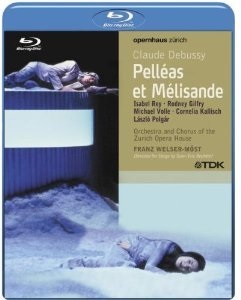
Debussy - Pelléas et Mélisande

Claude Debussy - Pelléas et Mélisande

Opernhaus Zürich, 2004

Franz Welser-Möst, Sven-Eric Bechtolf, Rodney Gilfry, Isabel Rey, Michael Volle, Lázló Polgár, Cornelia Kallisch, Eva Liebau, Guido Götzen

TDK

Debussy’s only full-length opera, composed in 1902, could be considered somewhat difficult, and indeed part of the reason for its difficulty could lie in the composer consciously striving not to imitate Wagner. If the Wagner influence is still evident in Pelléas et Mélisande however, Debussy takes the idea of music-drama a little bit further, making it difficult to find conventional melodies, leitmotifs or even a clearly definable plot, the almost mythological storyline flowing rather to its own pace, rhythm and purpose. In reality, it’s not a difficult opera at all, unless you bring such expectations to it, but rather, left to work to its own unique operatic language, allowing yourself to go with the flow, it’s actually easy to become caught up in the strange world that Debussy creates.

The strange nature of the opera and the musical arrangement that it consequently adopts undoubtedly have more to do with the nature of the source work for the opera, a symbolist play by Maurice Maeterlinck that relates less to the conventions of narrative cause-and-effect drama, but more to the internal states of the characters being made manifest in the world around them through objects, environments, landscapes. Their behaviours are therefore less easily defined, unconstrained as they are by conventional means of expression and communication. Musically, this is also how Debussy’s score operates. Trying to associate the music with the singers through the traditional form of expression then can be problematic and not lead to expected rational conclusions. Much better to let those elements just seep in, create their own resonances that are less literal and more impressionistic and suggestive.

As such Pelléas et Mélisande is not an opera that needs to be tied to any specific period – unless a director wants to make a specific statement – and to tie it to a particular time or place is likely to create social/environmental meanings that may be contrary to the intention of the piece. This means that the opera can either be set in that vague non-time-specific no-man’s land that opera does so well, or, rather more controversially, it is open to rather more extreme interpretations. The staging here by Sven-Eric Bechtolf for the Opernhaus Zürich in 2004 consequently can be seen as being either wilfully bizarre or just perfectly suited to the unusual nature of the opera. In outline, the story is not that complicated. Lost in a forest while hunting a boar, Prince Goland discovers a young woman, Mélisande, weeping by the side of a lake. He doesn’t know who she is, although there is a crown at the bottom of the lake, but rescues her and they are married. Mélisande however forms a closer attachment to Goland’s brother Pelléas, a relationship that, inevitably, is to have tragic consequences.

There is however more going on between the characters than is evident on the surface, each of them having hidden natures, each of them unable to fully relate to or communicate with one another. As a means of bringing this out, Bechtolf places the characters in some kind of winter fairy-tale kingdom to emphasise the nature of their isolation, while he employs full-size look-alike dummies for each of the characters to act as doubles for them, the characters more often speaking to the dummy counterparts and pushing them around in wheelchairs than relating to the actual people. It all seems rather obvious and it’s tempting to see the device as just an expression of how people are puppets being used by others for their own purposes, but that is also too obvious and, in a symbolist work where there is just as much emphasis on objects – hair, rings, towers – it’s appropriate that the characters are objects themselves (the split into halves indeed being the original definition of symbolism). In this light, and on a non-rational basis, what appears to be a bizarre conceit proves to be uncannily effective, and when the characters do communicate directly with each other – as opposed to interacting with dummies – it does force you to take more notice of what is being said.

How much you will buy into this depends largely on your tolerance for high-concept modern stagings and how much credence you give to the symbolist movement, since other than perhaps in the film work of Antonioni and his disciples, their style doesn’t have a great deal of relevance or influence and is not held in great regard nowadays, certainly not from a literary viewpoint. It’s important to note however that the staging is not a distortion of the intentions of the opera on the part of the producers, but rather, if it doesn’t adhere to the letter of the work, it is nonetheless perfectly in keeping with the spirit of it, and certainly matches the spirit of Debussy’s musical composition. Making use of a revolving stage, the production is certainly effective in its dreamy fluidity, but it’s also exceptionally well sung, particularly by Rodney Gilfry as Pelléas, but Isabel Rey as Mélisande, Michael Volle as Goland and László Polgár as King Arkel are all marvellous. The orchestra playing is superb, particularly in the excellent High Definition sound reproduction on the Blu-ray.